lundi 3 octobre 2016


vendredi 1 juillet 2016
jeudi 2 juin 2016
jeudi 12 mai 2016
Social Collaboration at the heart of Knowledge Management (r)evolution
Why the former Knowledge Management was never be fully adopted by employees ?
Following a previous blog (here)
summarizing how Atos internal Digital transformation has well evolved from
ZeroEmail™ over Social Collaboration to WellBeingAtWork, I would like to explain
a good side effect on how the Social Collaboration is disrupting the old
Knowledge Management.
It’s time to unleash
your Knowledge assets
Our Enterprises operates in a knowledge economy that is
undergoing significant transformation. You can no longer have critical
information locked into individual mailboxes, or folders and archives unavailable
to your employees and stakeholders.
A good Social Collaboration, consisting of an Enterprise
Social Network creates a global structure of so-called communities that should encompass all your organization, your
markets, portfolio and your customers. All communities and knowledge should be
globally available to your employees within a unique collaborative platform.
So why people are so excited about Enterprise Social
Networks ?
What I found within Atos after 5 years of promoting social
collaboration are the following benefits:
- It’s reduce internal emails overload and fewer meetings
- It’s accelerate peer support and knowledge re-use
- It’s share the Power of Knowledge (enterprise social technologies enable personal knowledge to become organizational knowledge)
- It’s work because employee daily business create context & audience automatically
- It’s work by connecting people (and no longer documents)
Knowledge Management versus Knowledge sharing
So whay so many old Knowledge Management solutions was not
working and was not adopted ? Mainly because the KM governance :
- wanted to manage and control all the company knowledge
- defined knowledge as a transferable good, which is centralized provided
- required knowledge sharing without providing any audience
But we all like to share knowledge on the web (wiki, blog,
social media…) for 2 reasons, if we get the right audience, if we can communicate and have social conversations with other people, if we get positive feedbacks from others (that promote
ours status as expert).
Without that we are not motivated to share or to use within
the old KM . Because we share knowledge when we have the right audience and
purpose, that motivates us and create the right context.
Knowledge Sharing is …not a new knowledge management tools,
no longer about storing knowledge on everything, but it’s about Knowledge just in time, that happens by connecting people in
formal and informal networks.
Knowledge communities can also give to the “knowledge” a
face and a name, accelerates the recognition and e-reputation of your staff.
To succeed the knowledge sharing and collaboration
(r)evolution, you need a coordinated organization (communities manager &
leaders), to adapt & simplify your technological landscape (with social as
the entry point) and a new culture and team spirit.
Knowledge sharing depends on the habit and willingness of
the knowledge worker to seek out and to be receptive to these knowledge
sources. The right digital culture, incentives, and so on must therefore be
present.
But not with a classic « change » culture but more with an « influence »
culture by using ambassadors, influencers, collaborative leaders with
visibility, by promoting success stories, by rewarding innovators and entrepreneurs
, by changing the old KM habits …there is a lot to be done !
A social networks properly integrated and promoted will be
adopt by many employees and can become your indispensable knowledge
infrastructure of your organization !
Are you ready to unleash your Knowledge Capital by evolving from “management” to “sharing” ?

mardi 12 avril 2016
mardi 13 octobre 2015
How the Atos internal digital transformation has evolved since 4 years

To
summarize our internal digital transformation work we did the last 4 years at
Atos, I wish to highlight the following 3 hashtags (well known on Social Media :)
#ZeroEmail
By creating a strong sense of urgency such as “Zero Email™
ambition, desired by our CEO Thierry Breton in 2011, we alerted and stimulated
in-depth
enterprise cultural changes.
Atos recognized the first that emails overload was a key
hurdle for collaborative transformation. And the replacement of internal emails
with collaborative technologies has resulted in a profound cultural shift at
Atos.
The working culture has evolved from one based on hierarchies and
command-and-control to a more open environment in which all employees and
leaders can engage with each other more quickly and easily thanks to many
online communities.
Atos Zero EmailTM initiative was very ambitious
and we are still impressed with the way everyone within the company has
responded to the challenge to radically change our way of working and the
progress we have made together – in three years we have reduced internal emails
by 70% in average. Reducing
internal email is a great outcome from better use of collaborative tools and
new behaviors.
#SocialCollaboration
Reducing
internal email was a “big plus” for employees who were suffering from email
overload, from now Social Collaboration
is our ongoing objective unleashing significant winnings by :
·
creating added value and more revenue
·
increasing project team productivity
·
accelerating our sales time to market
·
improving our customer satisfaction
·
generating collective innovation and ideation
We are
taking advantage of a new connected team culture and our goal is to generalize
this culture for all Atos current and future businesses.
Over the past 4 years, we have
laid a solid foundation to now reap the benefits of our efforts and
increasingly we are using the right tools for the right job; from our social
business network blueKiwi to Sharepoint for document management, Lync for
communication, online meetings and chat and e-mail for external contacts and
formal communications.
In addition to the shared
ambition to reduce our emails pollution, we have implemented many changes and
internal communications initiative’s to address some confusions, middle
management resistance or fears.
Our change strategy was mainly to :
- Educate the organization about why we need to change and how culture is changed in order to gather support for cultural change across the organization (5000 managers completed dedicated training for leadership in a collaborative environment)
- Develop a comprehensive communications and training plan that includes all the cultural levers that create change across the organization (we promoted company values in dedicated campaign and also fun training personas videos available here : https://www.youtube.com/playlist?list=PLJ2TzHPQDM9P65uRap2_PPqEqX-QYpxSm
- Enhance employee engagement, by applying effective change management principles by involving employees in the change process; (we record email addict testimonies stories to recognize their challenges and path to liberation)
- Mobilize senior leaders to be accountable for the Collaborative culture they create in their areas with dedicated bonus targets (first target with their own social network usages and second target with their community health achievements)
The key success factor is
especially to start with strong Change influencer’s network with support of few
seniors’ leaders to create business exemplarity.
#WellBeingAtWork
As a
consequence, we strengthened our Wellbeing
at Work initiatives, because we saw positive correlations between collaboration benefits,
employee engagement and digital cultural transformation.
For us a truly Wellbeing at Work go through cultural adaptation to digital attitudes like the rise of
authenticity, transparency, crowd-collaboration,
flexibility , less bureaucracy, and an effective leadership by exemplary .
In this continuity, we are simplifying our leadership model to become
more agile, customers communities oriented, fully networked mainly because high
number of our knowledge workers are moving from a traditional pyramidal model
to a collaborative networked community model with less complexity and more
crowd collaboration
Today many analysts and experts recognized
that Atos internal digital transformation has well evolved from ZeroEmail™ over
Social Collaboration to WellBeingAtWork!
(see quotes selection below )
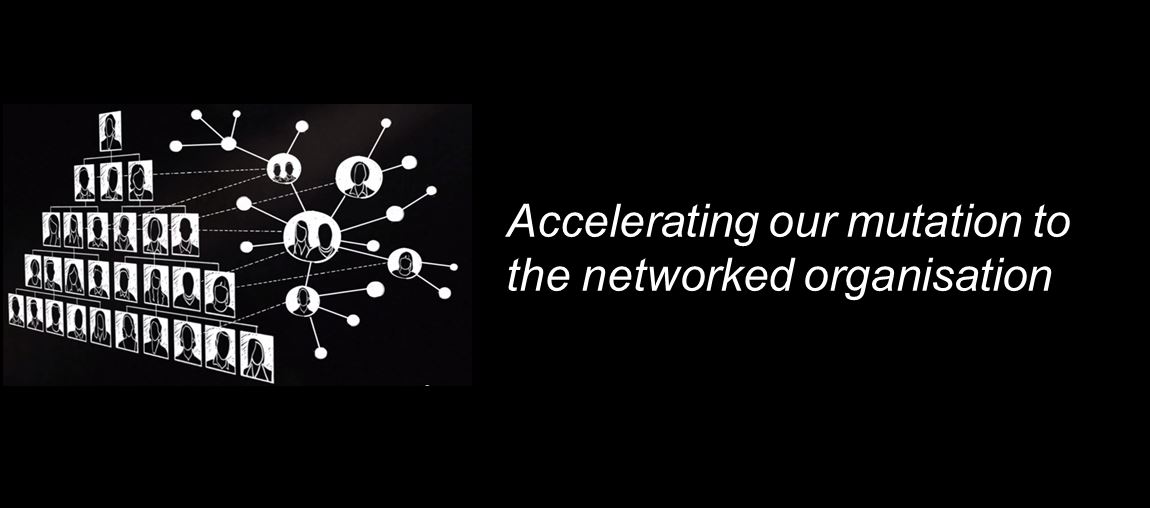
Our next challenge will be to succeed this move
from a traditional hierarchy based organization to a collaborative, community
led organization.
Honestly transforming towards a
collaborative & networked enterprise is a long term marathon. Not really a “journey”
without goal, but a kind of “relay race” in which we regularly welcome
newcomers.
I will come back later to tell
you how we will accelerate our mutation to the networked enterprise.
Key Analysts and Experts recognition quotes :
From Gartner :
“No Email
initiative provides valuable lessons on driving big change through Social
Collaboration. A cultural transformation of this kind and magnitude is very
rare. To prepare its workers and
managers for this major transition Atos invested significantly in a
communications, recognition and training programs.”
From Harvard Business Review :
“Atos’s
experience is evidence that an effective collaboration platform isn’t just a
tool for communication, it’s a key to
achieving smooth, integrated growth and competitive advantage
in the knowledge economy.”
From Bloomberg Business :
“The Social network
changed the method of working . It’s
become more horizontal, less hierarchical.
“Like other
corporate social networks, BlueKiwi lets employees create online groups where
they can exchange information or work together on projects. Co-workers can
review one another’s documents and videos through the network and post comments
on them there rather than generating a blizzard of reply-all messages.”
From Forrester :
“The Atos Zero Email program won the
Forrester Groundswell Award for Excellence award in the Employee Collaboration category”
From PAC :
« Atos ready for the real Digital
transformation business »
mardi 29 juillet 2014
Collaborative leadership starts with you !

The flow of 2.0 technologies and employees expectations in organizations, especially the younger generation, converge on Mass Collaboration. Enterprise Social Networks are just the support for this managerial (r) evolution.
Relevant response to many changes and companies transformation challenges (size companies increase, remote locations, teleworking, team management more transversaly skills globalization, nomadism ...); collaborative and networks tools can reinvent digital cooperation and accelerate proximity management that 2.0 experts called “Collaborative Leadership” ... and that, as practitioner , I try to successfully implement in large organizations.
But with the implementation of those ESN and strong challenges that they generated, like porosity, instantaneous communication, transversality, transparency ... it is more and more obvious that these collaboration tools are a small part of the solution.
Face of substantive
issues it is urgent to transform our managerial cultures and help all managers,
team leaders, project managers or executives to understand their new roles and
become true leaders of communities. Able to show the way for (re)mobilizing
people by giving vision to the goals of the team, facilitating knowledge
sharing, being exemplary to develop employee engagement.
In fact only a new dynamic management style, based on the animation, listening, and stimulating collaborative behaviors allow our employees to find new landmarks and become fully commit to the goals that has been defined jointly.
In fact only a new dynamic management style, based on the animation, listening, and stimulating collaborative behaviors allow our employees to find new landmarks and become fully commit to the goals that has been defined jointly.
We are in an age of many cultural breaks; It’s time to implement and stimulate ourself the development of new business management mindset, most Collaborative, most Creative, and especially more efficient thanks to the animation of digital Communities.
Otherwise
our firm of the future, more agile, more innovative, more efficient and more
social, will struggle to emerge.
I hope I have convinced you that new managerial Cultures and Communities
Collaboration are imperative to success.
If you want to see what the failure to
collaborate will looks like, look at some of your competitors :)
If you want to see what
the potential for collaborative success looks like, look in the mirror; Collaborative leadership starts with you !
mercredi 11 juin 2014
Enterprise cultural change beyond Social Collaboration

The way we work is shifting.
We see that in visible ways and other subtle ways. Even large companies like Atos, CEMEX, Procter & Gamble, Unilever, Sanofi or Dassault,are strongly committed in Social Collaboration transformation, realizing that it is the best way to stay ahead of the curve. Those with a real competitive advantage intuitively understand innovation and creativity as essential to meeting market demands and crucial in facing our collective sustainability challenges. The future of work as we know it is shifting from an outdated directive approach toward collaborative frameworks that inspire us to engage in new and different ways with our work and with each other.
However, unlike other early adopters who have deployed social collaboration to address specific key business issues, Atos has deeply implemented social collaboration globally in all its operations. They focused first on business transformation addressing the collaborative and management culture.
By moving the organization towards a collaborative environment that is not primarily based on email but on Enterprise Social Network and by promoting collaborative behaviors, Atos is achieving the following cultural shifts:
From Individuals to Communities
76,000 employees joined blueKiwi, the Atos enterprise social network, collaborating together in 7,500 communities. This strong communities landscape has removed many invisible silos and is making a global organization “closer” and “smaller”.
Also by creating open communities they enabled new transversal cultural collaboration with connected employees able to find the expert, share knowledge, work together and socialize no matter where they are based. Many people are leaving their individualism mindset to adopt the collaborative culture.
Their Zero Email ™ program is engaging all employees with a much more open and collaborative management style and ensuring everyone is well connected to goals and ambitions. It’s essential to be open and transparent, building on trust and respect if you expect to get the full support of your people to your strategy.
From Controlling to Leading: The Collaborative Leadership factor
Over the last few years a lot of effort was spent on perfecting global processes with a Lean approach; reducing costs, restructuring, enlarging offshore capabilities and integrating large acquired organizations with a global top down mindset.
With the implementation of transversal communities in collaborative tools and new ways of leading teams based on participation, we have enabled a new collaboration mindset with engaged employees. Today experts are taking pride in sharing their expertise. People are starting up their own communities, to share interests and help each other out. Social collaboration is changing the nature of our organization into a new unique and social culture.
For Atos, a collaborative culture requires a new management style and they invested first in change management and support to Top and middle managers: 5,000 Senior staff trained on how to lead in a Zero Email company (LITZEC modules) and senior executives realized the benefits early by leading by example in their respective online communities
Enterprise Communities Management had a pioneering role for managers and team leaders. In large communities this helped manage the cultural shift for their landscape and collect business outcomes through their complementary communities.
From Experts to Ambassadors
Another great lesson from this Zero email ™ initiative is to be systematic with the adoption program. Atos has thousands of ambassadors (3,500 in February 2014) and champions training their peers and socializing the tools internally. This is key to driving fast adoption.
Another key was creating communities for experts to answer questions raised by colleagues, customers, and partners instead of using classic workforce management strategies to assign employees to tasks.
By engaging volunteers and strengthening communities with ambassadors, digital networks generate great benefits that we see through success stories. Many communities are now reinforced by voluntary ambassadors and experts. As an example, an open French community “IT & Process” is a great success with adoption of volunteers where engaging contributors really helps the IT department to improve project implementation, documentation or solving incidents. IT Management France improved awareness and understanding of local IT support to all employees by sharing real time information, best practices and tips in their open community.
From Information overload to time for business
Atos recognize that email is a key hurdle for collaborative transformation. And the replacement of email with collaborative technologies has resulted in a profound cultural shift at Atos. The working culture has evolved from one based on hierarchies and command-and-control to a more open environment in which employees and leaders can engage with each other more quickly and easily.
Emails assigning employees to tasks are being replaced by discussions in online communities where managers and employees can communicate with each other, generate new ideas, and share best practices.
Every day Atos sees that collaborative operations contribute to more efficient team work. They measured that 25% of work time previously spent every day on email activities, is now spent on business activities for pilot project communities.
It is also Interesting to see that for some project works they move from traditional resource allocation to open co-creation, from a classic teaming approach to a scalable work flow. In summary from emails to Collaboration.
Key Atos results are: also visible in this infographic here
- Reducing internals email disruption and overload by 60% : from 100 to 40 email per week/per employee
- Multiplying by 20 our collaborative contributions: 2M views were performed during December 2013 with more than 300k contributions posted in a month.
- Certifying more than 220 business processes to be zero emailTM certified
Today teams and communities who have made the change by implementing collaborative habits in addition to our Enterprise Social Network are seeing progressively that their employees’ collaboration has a tremendous value for our customers, projects and services. And many employee testimonies explain their key benefits of their social collaboration journey in term of Innovation, bid and employee support, time saving, networking and communication, knowledge sharing, for greater well-being at work.
In conclusion
Why do you need to achieve these large-scale cultural changes in your business?
- So that your Enterprise Social Network implementation will not fail
- To promote smart methods of collaborative working: promoting good collaborative behaviors and tools for good business practices
- To accelerate new solutions / offerings: and the opportunities to create new ideas, products, and services with crowd-innovation communities
- To remain competitive and productive: knowledge is your greatest asset; it grows when it is shared
- To meet the employees needs with interest communities and by sharing knowledge and best practices, interest or passions.
And a last lesson learnt from the Zero Email Atos experiences: be patient!
You’re not going to turn into a social business just in few months. They set a long term timetable to get to Social Collaboration objectives and decrease internal email, and it will still take more time before achieving their final goal.
Social Collaboration implementation is a marathon, not a sprint. Its transformation begins in the inside of our organization and gradually grows out to become a real social business ecosystem with employees, partners and customers.
dimanche 5 janvier 2014
5 Resolutions to becoming a Collaborative Leader in 2014

“Collaborative Leadership” is a very particular type of working together and it’s this essence or practice of "true Collaboration" that should not be confused with other Social trends.
Mc Kinsey Global Institute find that Social technologies, when used within and across enterprises, have the potential to raise productivity of high-skill knowledge workers that are critical to performance and growth in the 21st century by 20 to 25 %. However, realizing such gains will require significant transformations in management practices and organizational behaviors.
Companies that understood this challenge and have implemented collaborative habits in addition to their Enterprise Social Network are seeing progressively that their employees’ collaboration has a tremendous value for their customers. Their employees are able to give the best support experience if they have the information, resources and experience of internal experts. A employee may not always have the reply the customer needs, but they will have access to the knowledge of the entire organization to resolve the problem, issue or win a bid.
Other analysts predicted that "Mass Collaboration" will be a huge step forward for mankind in general. It will shape the workplace in the decades to come... We know the theory and their vision, but for Leaders and Business man; how it’s work?
Why Should You Be a Collaborative Leader?
The key benefit of being a Collaborative leader is that your colleagues will enjoy working together within your team. Also your prospects/customers/stakeholders will seek out your expertise and benefits' behaviors. If you’re not a Collaborative leader in your field, someone else will be, so step in and start becoming one today!
Collaborative leader is a powerful network commodity. Doors that were once closed are now open, people listen you and will thank for sharing your knowledge; in brief your business will grow organically thanks to the following resolutions.
5 Resolutions to becoming a Collaborative leader:
1- Be a Facilitator.
The first resolution to being a Collaborative Leader is thinking like a facilitator rather than an authority figure. This means Collaborative Leaders don’t tell their team what to do, instead they ask themselves, “How can I bring my team what is necessary to get the job done?” This question implies an open and trusting attitude towards others on the team.
Collaborative Leaders believe in their team’s abilities, value their ideas and allow them to make decisions in order to get the job done.
2- Share your Knowledge.
The Collaborative leader you want to be is one who wants to share knowledge and help people be more successful. Ask yourself if you genuinely care and continuously demonstrate a strong purpose to help others? If not, you need to!
If you believe that your knowledge is valuable to others and you have the passion to share it, then you are on the right path.
3- Inspire others and help peers
It’s important to think about finding the message/post that will resonate in your community/audience—the one that will inspire action and motivation. Make sure that your message is not too constrained by your corporate culture and adversity to risk.
Concretely; write a post/ blog about the topic you are an expert in and share it. To be a Collaborative leader, you must recognize that what you have to say (i.e., your knowledge and expertise is valued by others)
Also find peers and friends within other Communities in your domain. Repost their Post or tweets, comment on their blogs, do them favors and help you each other’s.
4- Empower, understand and trust your people
Leader who are becoming Collaborative are daily investing to:
- Empower people; by creating new production lines of innovation fueled by the collective knowledge of the workplace and their community.
- Understand people; by leveraging the human face of data based on a fundamentally new source of behavioral and sentimental insights. If you are going to talk about Collaboration, it is important you involve your employees from the start. Listen to their ideas, needs, suggestions and incorporate their feedbacks in your strategy.
- Trust people by deploying new organizational designs and processes which optimize workplace talent and open up agile marketplace engagement.
- Reward your people collectively; If your organization focuses on rewarding employees for individual contributions as the driver of success, it will be quite hard to encourage employees to share and communicate with each other. There is nothing wrong with rewarding your employees for personal results, but it is equally important to recognize and reward Collaboration and teamwork (eg. Communities KPIs will have more impact than individual monitoring for adoption)
5-Be committed to your Community
As a Community leader, you have to be visible and accessible, to spend time online and offline (informal team meeting), to celebrate business successes or personal event, to appreciate and say thank you and of course by responding promptly.
People are more important than technology. You need to hire people who care about people. If you hire timid people in your teams, it doesn’t matter what you social network strategy is if your company is full of withdrawn or grumpy colleagues !
Also ensure the development of your community members; give them greater autonomy in expressing their genius, creativity, energy. You task is to support and motivate them!
In conclusion to become a Collaborative leader in 2014, you need talents, perseverance, transparency, networking, listening, exemplarity and always taking decision after collaborative discussions.
"It's not about you know anymore, it's about what you share with transparency to your colleagues" Quote from Anthony Bradley (Social Organization book author)
Author note :
“I wish all of you a wonderful and a Collaborative 2014. I hope this new year will bring lots of opportunities to innovate, change, explore and transform together our business life to the Collaborative Leadership”
dimanche 3 novembre 2013
3 frameworks to transform your Communication ecosystem to a truly Collaborative Enterprise
Back to the vision
Today in
Social businesses, Communications is an indispensable practical strategy to explain vision, create synergies, align knowledge, promote Collaborative
attitudes and behaviors. The societies and organizations are complex human
groups organized in networks with multiple connections within and outside of
their environments where people’s experiences imply the change of time and territories
evolution (functional framework).
The
successful Communication strategy journey must pass by a new functional architecture and social technologies that facilitate
the logistics of the flow of information’s in social frameworks that have thin borders,
coordination governance, interactions rules and policies.
So we
have to explain the full map of social and organizational behaviors to develop a comprehensive framework under
communication ecosystem where formal and informal exchanges coexist to
improve business performance.
We
observe that organizations that are moving to the Social collaboration are redesigning
their models, theirs behaviors, And it’s important to clarify what you want to
achieve to become a truly Collaborative
enterprise before speaking and implementing Collaborative solutions and ESN
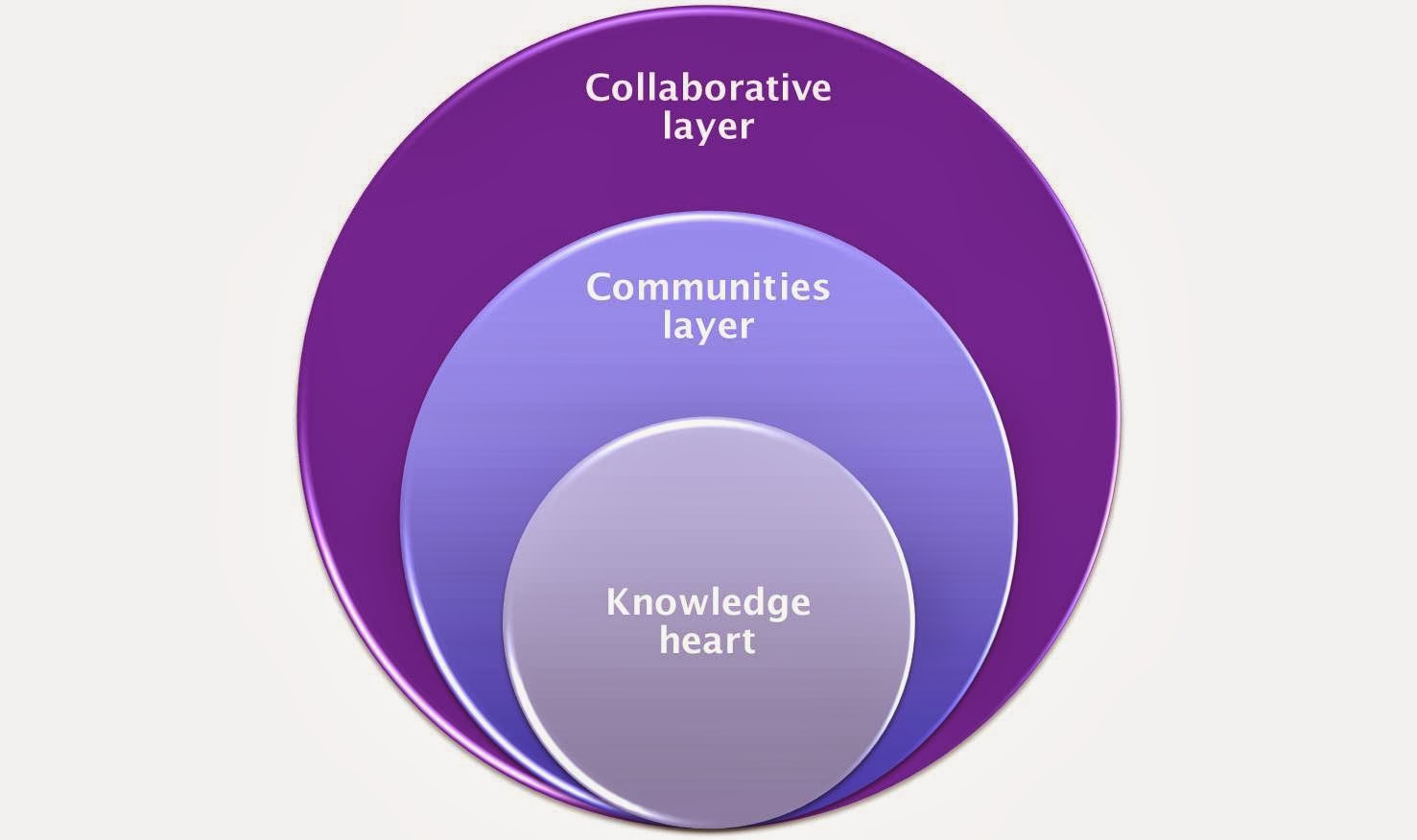
A good diagram is better than a long explanation:
Here are the 3 keys to transform our business model to Mass Collaboration open to the world but with strong and secure layers.
1- Knowledge heart : is capitalizing on our internal skills and expertises to protect the Communities data’s and knowledge of the company in its (secure) heart.
2- Communities layer : is progressively freeing all energies of internal communities and protecting the heart like a filter for external communities (customers, partners) It’s also transforming our ways of communicating with many new contents owners and influencers to manage…
3- Collaborative layer : allowing the dissemination of our knowledge and expertise to public social medias and promoting co-contribution with external stakeholders. This new layer will develop many digital bridges with the external world for Expertises , for Employer Branding, Employee videos, for open innovation…
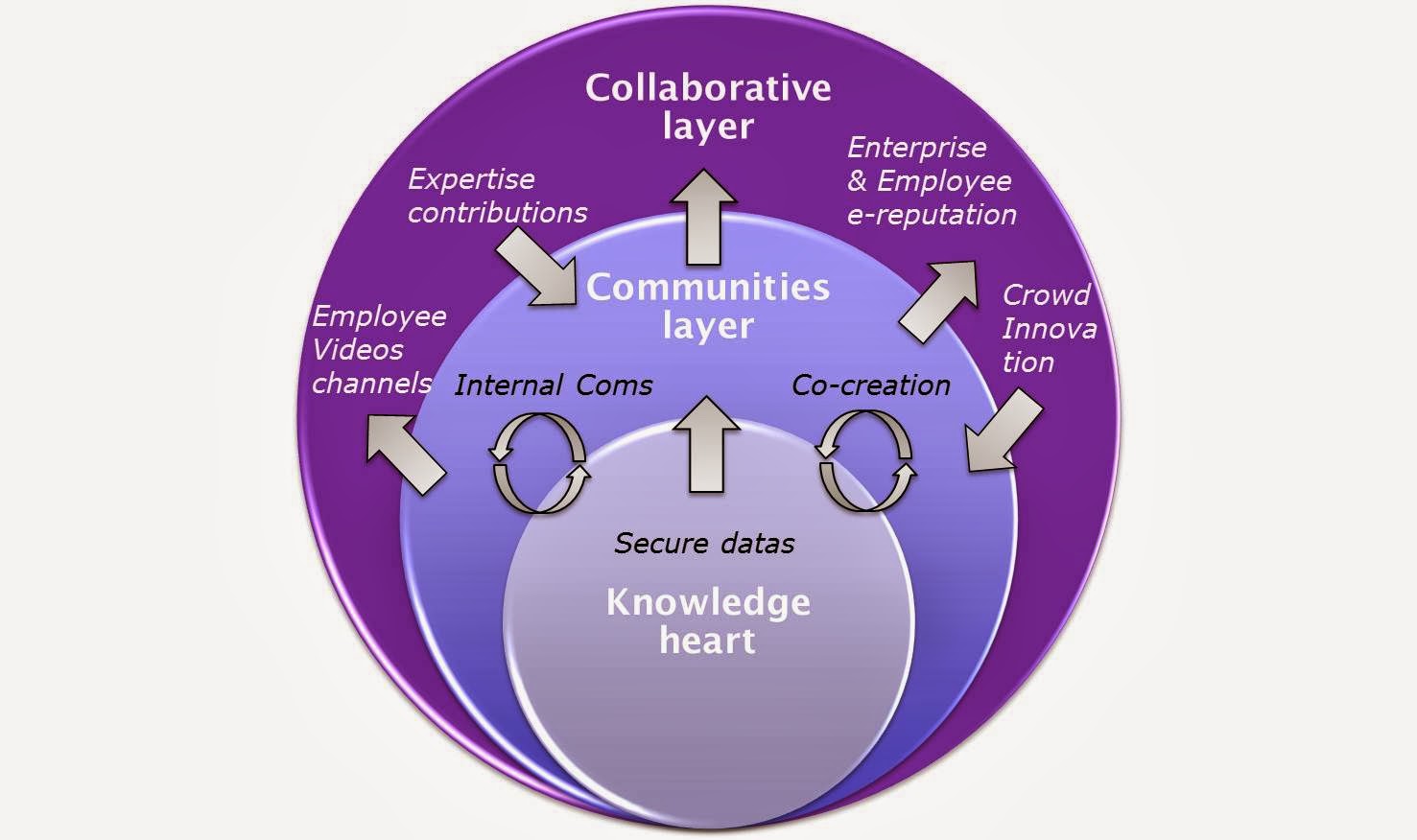
Note : this diagram show the key interactions between the 3 complementary layers, the Collaborative layer represent the external world with which all Social organizations must increasingly interact in both directions.
The
only feasible way to realize the Collaborative and Digital Workplace is to
start with a vision and above guiding principles and then explore potential
paths to get there, taking one step at the time.
Also by addressing key
questions and challenges to transform your internal communications strategy :
- How will we secure our knowledge and static information of organizations?
- Is there a future for our existing Intranet ?
- How to move from push to pull Communications, from monolog to dialog collaboration, from long text to short videos?
- How do we teach and manage employee and experts to collect, share and promote externally their information’s?
A
key reason for introducing Change in a step-by-step approach is to make it
easier for people to adopt these changes. That way they can also change their
ways of working to something better.
This is
the “essence” what we are trying to do – to improve smarter ways of working,
wellbeing at work, employee networking, social links and thereby increasing
knowledge worker productivity.
jeudi 5 septembre 2013
Introduction au Blog

Il est urgent de transformer nos cultures Managériales
L’afflux des technologies 2.0 et les attentes des collaborateurs en entreprise, en particulier les plus jeunes, convergent vers la Collaboration de masse. Les Réseaux Sociaux d’Entreprise (RSE) sont le support de cette (r)évolution managériale.
Réponse pertinente aux transformation et nombreux changements que vivent les entreprises (accroissement de la taille des organisations, éclatement et éloignement des sites, télétravail, gouvernance et management de plus en plus transversal, mondialisation des compétences…), les outils et réseaux collaboratifs permettent de réinventer la coopération digitale et surtout un management de proximité que nos amis d’outre Atlantique appellent le Collaborative Leadership...
Mais avec la mise en œuvre de ces RSE et les enjeux qu'ils induisent tel que la porosité, l’instantanéité de la communication, la transversalité, la transparence…il est de plus en plus évident que ces outils de collaboration ne constituent qu’une partie de la solution.
Face aux enjeux de fond il est urgent de transformer nos cultures managériales et d’aider les managers, chefs d’équipe, de projets ou directeurs ayant de nombreuses équipes à comprendre leurs nouveaux rôles et devenir de vrai animateurs de communautés (Community Leader) qui montrent la voie aux équipes, mobilisent en redonnant du sens aux objectifs de la communauté, et facilitent le partage des connaissances pour susciter l’adhésion.
En effet seule une nouvelle dynamique managériale, basée sur de l’animation, l’écoute, et la stimulation des comportements collaboratifs permettra aux employés de trouver leurs nouveaux repères et de s’engager totalement vers l’objectif qui aura été défini conjointement.
Nous entrons dans une ère de nombreuses ruptures. Et ce blog est un appel à l'émergence d’une nouvelle culture d'entreprise, plus collaborative, plus créative, moins individualiste avec l’animation des communautés. Sans quoi l'entreprise de demain, qui se veut plus agile, plus innovante, plus efficace, aura bien du mal à voir réellement le jour.
Note :
Ce blog est avant tout un support de réflexion sur le Collaborative Leadership et deviendra peu à peu un guide pratique pour les Community Leader. Il est fondé sur mes expériences passées de Consultant en organisation et pilotage de projet transversal, sur mes anciennes activités d’animation de la vie interne et du renforcement du lien social auprès de 300 consultants (activités socio-culturelles, soirées, conférences, team-building, animation d'équipe, coaching…), ainsi que mes récentes recherches et travaux pour accompagner la transformation d’un Groupe international de 77000 personnes vers les usages collaboratifs et le déploiement d’un RSE à grande échelle.
lundi 2 septembre 2013
Community Managers, les nouveaux martyrs

« Le Community Manager a la patience d’un missionnaire, l’écoute d’un confesseur, la douceur d’une bonne sœur et l’âpreté à la tâche d’un bénédictin. C’est le Community Manager qui industrialise la génuflexion et le repentir des organisations devant la fureur numérique, c’est lui qui calme, rassure, temporise. Le Community Manager est en quelque sorte une figure moderne de la pénitence et du pardon. Peut-on parler de nouveau martyr ? Le corps transpercé de flèches en forme de tweets vengeurs ? »
Pour la suite, je vous invite à lire le très bon blog de David Abiker qui illustre avec brio le métier de Community Manager comme celle d’une vocation.
http://www.davidabiker.fr/community-manager-les-nouveaux-martyrs
dimanche 1 septembre 2013
Les principales facettes d'un Management Collaboratif (Collaborative leadership)
Pour relever les défis et enjeux décrits en Introduction (arrivée des nouvelles générations, ouverture de l’entreprise aux technologies collaboratives, transversalité, transparence…) le manager du XXIe siècle doit revoir en profondeur ses méthodes et anciennes habitudes afin de pratiquer un Management Collaboratif qui combine de nouvelles facettes et responsabilités.
Appréhendons les 3 principales facettes d'un Management Collaboratif (Collaborative Leadership)
Le manager collaboratif doit être à la fois un :1- Animateur de Communauté
- Instigateur de collaboration et de la coopération au sein de sa communauté, Il définit le cadre de l’activité, motive, responsabilise et anime son équipe au quotidien.
- S’il est chef d’équipe, l’animateur fixe les objectifs et définit les activités de sa communauté. Il est garant de la Communauté et de son mode de fonctionnement (objectifs, livrables, plannings des contributions majeures…).
- Il crée du lien et une émulation entre ses collaborateurs à l’aide d’activité extra-professionnelles (déjeuner, séminaire, soirées, …).
2- Coach d'équipe
- Le Community Leader en tant que “Coach” fait des retours systématiques et réguliers, valorise et récompense la performance de ses équipes.
- Il attache une importance particulière au développement de ses co-equipiers.
- S’il est supérieur hiérarchique, le Manager échange régulièrement avec ses collaborateurs, sur leurs points forts et axes de progrès, sait valoriser leurs capacités à collaborer et les aide à capitaliser sur leurs réussites collectives.
3- Leader d'influence
- Le Manager sait pratiquer un management d’influence en rupture avec le management d’autorité traditionnel.
- Il donne la vision, explique les enjeux et les objectifs de la communauté après une phase de collecte des avis des membres de l’équipe.
- Il s’agit d'influencer sans imposer et de stimuler la collaboration en faisant adhérer chacun sur des objectifs au niveau entreprise, communautaire et individuel.
- Pour réussir, il doit avant tout promouvoir la culture du « feedback » et libérer la parole des contributeurs
En résumé les clés du succès du Manager Collaboratif 3.0 (à la fois animateur, coach et leader d'influence) sont les suivantes :
- Désigner le cap, et la vision
- Faire adhérer aux objectifs, aux enjeux de la communauté
- Ecouter et reconnaître les contributions
- Expliquer les décisions
- Dynamiser l’action de la communauté
- Agir sur les motivations collectives et individuelles
- Faire progresser l’équipe
Note : En
suivant tous ces conseils, vous deviendrez un vrai Manager Collaboratif, coéquipier
d’une ou plusieurs communautés avec des collaborateurs motivés ….
Remarquez comme tous ces termes portent le préfixe
« co » du latin « cum » qui signifie
« ensemble ». Vous partagez un but et cette seule ambition commune
crée votre communauté. Vous l’animerez donc dans la concertation, chacun étant
contributeur et co-contructeur de la mission.
vendredi 30 août 2013
Bonnes pratiques pour dynamiser les Communautés internes

Développons dans ce post quelques principes directeurs et bonnes pratiques de Communities Management qui sont valable autant pour les responsables et animateurs de communauté que pour les gestionnaires de plusieurs communautés (Communities Manager).
Ne décevons pas nos collaborateurs avec la rigidité et les procédures à faire perdre la tête, laissons la place à l'initiative et à la reconnaissance des efforts, donnons leur envie d'aller encore plus loin et de partager leurs savoirs et idées...
Voici quelques Principes directeurs d’un Management agile et creatif en Entreprise
Mobilisons nos intelligences et savoirs au service de l'entreprise.
Le mot le plus important à retenir c’est le « partage » des connaissances, c’est une vraie rupture des comportements qui entraîne une évolution des organisations vers l’ouverture et la collaboration de masse.
Chaque communauté doit avoir un objectif métier clair et partagé (business purpose), si ce n’est pas le cas, il existe des techniques pour dynamiser les échanges et faire réagir les co-équipiers tel que :
Voici quelques illustrations des bénéfices constatés par la collaboration à travers des communautés digitales :
La création de communautés d’expert et d’intérêt au sein de l’entreprise renforce la capitalisation des savoirs et permet à l’entreprise et aux collaborateurs la mise en place d’équipes élargies. Elle facilite l’activité opérationnelle et améliore l’organisation en reliant les personnes à différents niveaux sur des centres d’intérêt communs.
Les communautés de pratique sont les premiers carburants d’un réseau social interne.
Les communautés de commerciaux partageant leurs informations en temps réel favorisent le « time to market » et une meilleure utilisation des ressources. Elle se traduit directement par une optimisation de la productivité des équipes .
Le fonctionnement en communauté accroît la satisfaction des personnes et renforce le lien social entre ses membres par l’augmentation du nombre de collaborateurs interconnectés et impliqués dont l’expertise est reconnue par leurs pairs.
Un dernier exemple en conclusion (et les exemples des bénéfices ne manquent pas), l'insertion de nouveaux collaborateurs dans une équipe projet est bien plus facile; plus besoin de faire de la spéléologie dans nos boites email, ils trouvent l'histoire du projet qu'ils rejoignent tout simplement en devenant membre de la Communauté projet.
Osons changer !
Désormais, on innove, on partage et surtout on collabore ! Seules la rapidité et la coopération permettent de rester dans la course de l’économie mondialisée.Ne décevons pas nos collaborateurs avec la rigidité et les procédures à faire perdre la tête, laissons la place à l'initiative et à la reconnaissance des efforts, donnons leur envie d'aller encore plus loin et de partager leurs savoirs et idées...
Voici quelques Principes directeurs d’un Management agile et creatif en Entreprise
- partageons nos connaissances et informations
- instaurons des pratiques souples,
- mettons les utilisateurs finaux au cœur des projets collaboratifs,
- œuvrons pour le dialogue permanent avec les directions métier,
- optons pour la transparence et l'arbitrage des risques,
- anticipons les résistances,
- hiérarchisons les priorités,
- examinons et adaptons pour encore plus d'agilité...
Mobilisons nos intelligences et savoirs au service de l'entreprise.
Le mot le plus important à retenir c’est le « partage » des connaissances, c’est une vraie rupture des comportements qui entraîne une évolution des organisations vers l’ouverture et la collaboration de masse.
Chaque communauté doit avoir un objectif métier clair et partagé (business purpose), si ce n’est pas le cas, il existe des techniques pour dynamiser les échanges et faire réagir les co-équipiers tel que :
- Mettre en œuvre un plan éditorial pendant les premières semaines d’adoption + plan de formation et sessions d’échange et trucs et astuces de la semaine
- Communiquer des histoires vraies du business et mettre en avant les succès et livrables des membres
- Mettre en avant les sujets « chauds » ou les vraies préoccupations de la communauté. Exemple : pourquoi perdons-nous des parts de marchés chez tel client ? Quelles sont les raisons du dérapage du planning sur tel projet informatique et les pistes d’amélioration proposées ? Réponses et collaboration garantie en retour.
Voici quelques illustrations des bénéfices constatés par la collaboration à travers des communautés digitales :
La création de communautés d’expert et d’intérêt au sein de l’entreprise renforce la capitalisation des savoirs et permet à l’entreprise et aux collaborateurs la mise en place d’équipes élargies. Elle facilite l’activité opérationnelle et améliore l’organisation en reliant les personnes à différents niveaux sur des centres d’intérêt communs.
- Exemple : recherche d’une expertise spécifique, disponible pour une mission à l’international. Seule une question ouverte dans la communauté d’intérêt permettra d’obtenir des réponses de candidats intéressés.
- Exemple : Les Communautés d'experts sont également un bon moyen d'identifier les personnes clés dans l'entreprise et de les accompagner pour communiquer en externe des convictions et savoirs sur une offre/service/expertise via les réseaux sociaux publics (blog, linkedIn, Twitter, Slideshare, Prezi...)
Les communautés de pratique sont les premiers carburants d’un réseau social interne.
- Exemple: Une centaine d’acheteurs d’un grand groupe Industriel réunis dans une communauté de pratique. Ils viennent de toutes les usines et partagent désormais leurs bons plans via le réseau social d'entreprise. Après une première réunion de lancement qui rassemblait le premier cercle d'acheteurs dans le cadre d'un séminaire, le leader de la communauté avance un argument clé pour convaincre les hésitants à se lancer dans le partage collaboratif : la promesse qu'aucune question posée ne restera plus de 24 heures sans réponse ! (et çà marche)
Les communautés de commerciaux partageant leurs informations en temps réel favorisent le « time to market » et une meilleure utilisation des ressources. Elle se traduit directement par une optimisation de la productivité des équipes .
- Exemple : contribution participative sur un même livrable pour un client (proposition commerciale à préparer pour un client en 5j ) ou recherche d’une nouvelle ressource au sein d’un projet en situation tendue
Le fonctionnement en communauté accroît la satisfaction des personnes et renforce le lien social entre ses membres par l’augmentation du nombre de collaborateurs interconnectés et impliqués dont l’expertise est reconnue par leurs pairs.
- Exemple : Evaluation par les membres eux-mêmes des contributions à la communauté par les commentaires, les boutons « like » et évaluation des idées. Ce besoin de reconnaissance naturelle (e-reputation) donne de la visibilité légitime aux collaborateurs, accélère leur accès aux connaissances, à l’auto formation et dynamise leur mobilité et leur carrière dans l’entreprise.
Un dernier exemple en conclusion (et les exemples des bénéfices ne manquent pas), l'insertion de nouveaux collaborateurs dans une équipe projet est bien plus facile; plus besoin de faire de la spéléologie dans nos boites email, ils trouvent l'histoire du projet qu'ils rejoignent tout simplement en devenant membre de la Communauté projet.
Inscription à :
Articles (Atom)